Operating a semi truck now costs more than it ever has. The industry-average cost per mile climbed to $2.336 in 2025, up 3.4% from the previous year, driven in part by an 8.6% increase in repair and maintenance costs. The hidden costs of reactive repairs push that number even higher, showing up as towing bills, lost freight, and idle drivers.
Most operators already know their trucks need regular upkeep. The real challenge is structure. Without a set schedule built around mileage and time intervals, critical maintenance tasks like oil changes may be deferred, inspections become reactive, and small issues quietly compound into breakdowns. A dependable semi truck preventive maintenance schedule replaces that guesswork with a system designed to catch problems before they escalate.
Preventive Maintenance Service Intervals by Mileage and Time
A preventive maintenance schedule works best when it’s organized around clear triggers. The tiers below use mileage as primary markers, giving you a starting point for planning service fleetwide. Engine specs and duty cycles vary by original equipment manufacturer (OEM), so treat the intervals here as an industry baseline and cross-reference the manufacturer’s manual for your trucks.
Daily: Pretrip Inspection
A few minutes of checking the basics at the beginning of each workday is an essential habit for any fleet to adopt.
- Tires: Check pressure, tread condition, and dual spacing before pulling out.
- Lights and reflectors: Scan every marker light, headlight, and reflector for cracks or burnouts.
- Fluid leaks: Look underneath the truck for drips or puddles.
- Air system: Listen for hissing at the lines and fittings, then watch how long it takes the system to build up air pressure.
- Brakes: Give the brake components a visual check for wear or damage.
- Cab systems: Run through the gauges, mirrors, wipers, and seatbelts.
This walk-around catches small issues before they become breakdowns or safety violations. In large truck inspection data from the Federal Motor Carrier Safety Administration (FMCSA), about 22.6% of inspected trucks were placed out of service in 2023, with lights, periodic inspection compliance, and brakes among the top violation categories.
Routine Service: 10,000 to 15,000 Miles
This is the most frequent mileage-based stop on the schedule, built to catch inexpensive fixes before they escalate.
- Engine oil and filter change: Drain intervals vary by engine and duty cycle, so operators should always follow the OEM manual, especially with modern trucks equipped with PACCAR engines that may run extended intervals.
- Chassis lubrication: Service every grease point since dry fittings wear out faster than the rest of the truck.
- Air filter inspection: A quick check catches air flow restrictions before they affect fuel economy or performance.
- Fluid top-offs: Check the coolant, power steering fluid, and diesel exhaust fluid and top off as needed.
- Tire pressure and tread depth check: A quick check at this interval helps catch uneven wear early.
- Brake inspection: A basic visual check confirms whether components are wearing evenly or need adjustment or replacement.
Catching a small oil leak or a worn air filter at this stage costs far less than replacing an engine or turbo later.
Major Fluid and Filter Service: 25,000 to 50,000 Miles
Once a truck crosses the 25,000-mile mark, maintenance shifts from quick checks to real measurement and replacement work. Small wear that looked fine at the last service interval often needs closer attention here, since it tends to compound the longer it goes unaddressed.
- Fuel filter replacement: A fresh filter keeps contaminants away from injectors and protects fuel system performance.
- Air filter replacement: If skipped at the lower tier, this is the point to replace it.
- Coolant condition check: Testing supplemental coolant additive levels, along with a general condition check, helps protect against corrosion.
- Brake lining measurement: Measuring lining thickness against the wear limits set by federal regulations and adjusting as needed keeps braking performance where it should be.
- Steering and suspension inspection: Check tie rods, ball joints, and bushings for wear that may affect handling and tire life.
- Wheel bearing and alignment check: Perform a bearing check, plus an alignment check if wear patterns suggest it.
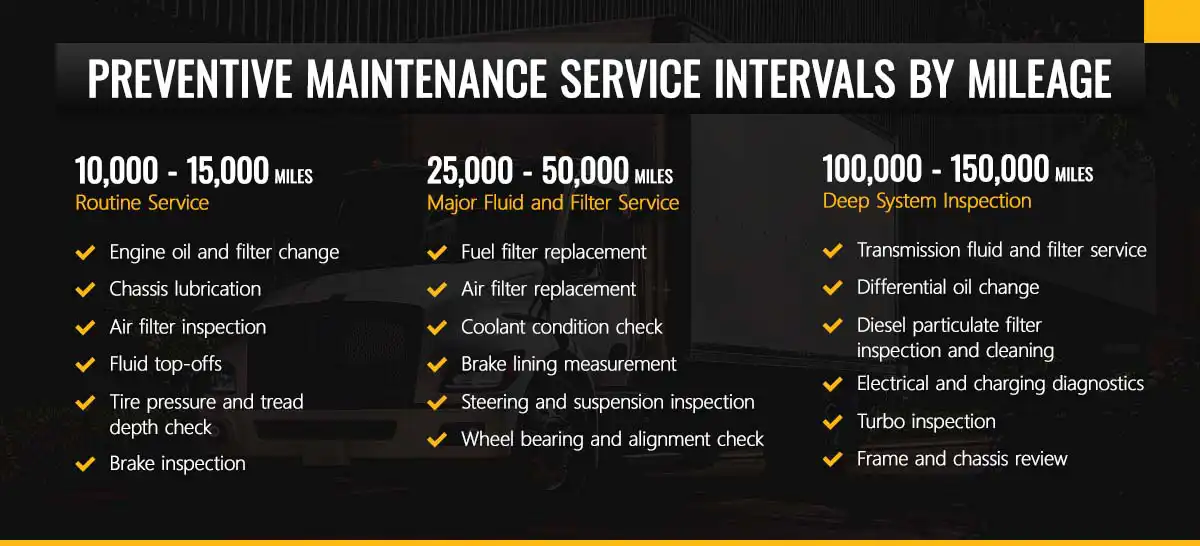
Deep System Inspection: 100,000 to 150,000 Miles
By this stage, drivetrain fluids, aftertreatment systems, and electrical components need closer attention. Skipping service here carries the most expensive downstream consequences.
- Transmission fluid and filter service: Fresh fluid and a new filter protect the transmission from high-mileage wear.
- Differential oil change: Fresh differential oil protects the ring and pinion gears from long-duty-cycle wear.
- Diesel particulate filter inspection and cleaning: Service timing depends heavily on duty cycle, with vocational trucks often needing attention sooner than linehaul trucks.
- Electrical and charging diagnostics: A full round of electrical diagnostics catches wiring and charging issues that often go unnoticed until they cause bigger problems.
- Turbo inspection: A turbocharger check confirms boost and oil flow are holding up as designed.
- Frame and chassis review: Check for cracks, loose fasteners, and corrosion that builds up gradually and is easy to miss day-to-day.
Mandatory DOT Annual Inspection: Every 12 Months
Federal regulations require every commercial motor vehicle to undergo a periodic inspection at least once every 12 months, and carriers that fall short risk real penalties under federal law.
Fleet managers can complete this review in-house with their own certified technician or through companies that offer DOT inspection services. Once a truck passes, the report or decal has to remain on the vehicle at all times as proof of compliance. A well-maintained preventive maintenance schedule is often the most effective way to pass the annual DOT inspection.
How to Set Your Preventive Maintenance Trigger
Every truck wears differently depending on how it’s used, so it’s critical to use the right trigger to alert whoever is in charge when a piece of equipment is due for service.
- Mileage-based triggers: These work best for consistent linehaul operations that rack up steady highway miles with predictable wear patterns.
- Engine-hour triggers: These fit trucks that idle heavily or run vocational and construction duty cycles, where engine wear accumulates faster than the odometer suggests.
- Calendar-based triggers: These act as a safety net for trucks with inconsistent or seasonal use, catching intervals that mileage or hours alone might miss.
Running all three triggers simultaneously and servicing on whichever fires first tends to be the most reliable approach. Telematics can also help operations monitor mileage, engine hours, and time concurrently.
Keeping Your Preventive Maintenance Schedule on Track
A schedule only works if someone owns it, tracks it, and follows through when a reminder goes off.
- Assign clear ownership: Every truck should have one designated person responsible for its preventive maintenance record, whether that’s the driver, a shop lead, or the fleet manager.
- Keep records accessible: Inspection documentation needs to stay on the vehicle and be easy to reach, whether that’s a paper folder in the cab or a digital record pulled up on a phone.
- Set reminders that match the trigger: A fleet that spends most of its time on the highway needs mileage alerts while one that idles heavily needs engine-hour tracking. Every truck needs a calendar reminder for its annual DOT inspection, regardless of which other trigger it uses. Telematics platforms can help keep tabs on each truck as your fleet grows.
An inconsistent or poorly tracked schedule is usually what turns manageable preventive maintenance costs into unplanned truck downtime and a much bigger repair bill.

Partner With Inland Kenworth for Comprehensive Preventive Maintenance for Your Fleet
A consistent preventive maintenance schedule keeps trucks compliant, predictable, and less likely to strand a driver on the shoulder. However, executing every maintenance tier often takes up valuable shop space and technician hours that many operations would rather spend on the road.
At Inland Kenworth, we have over 70 years of experience serving the trucking industry. We offer preventive maintenance services for all makes and models. For added support, we offer fleet services that combine preventive maintenance scheduling, telematics tracking, and 24/7 roadside assistance into one partnership. With locations throughout Southern California, Arizona, and New Mexico, our professional technicians are ready to help. Explore our semi truck service and repair options, or request a quote from your nearest location today.