

Running a fleet can be expensive, and every penny counts. Buying a commercial truck is a long-game investment. It’s how it holds its value that can shape your entire financial picture. The smartest fleet owners know that saving money is about using depreciation and tax strategies to keep more of their hard-earned dollars at tax time.
This guide provides general information on maximizing your fleet’s depreciation and tax deductibles. Note that your situation is unique. Always consult with a qualified tax professional and follow Internal Revenue Service (IRS) guidance.
How Truck Depreciation Works for Your Business
Commercial truck depreciation is the gradual decrease of a truck’s cost, or value, over its useful life. For example, a new Class 8 truck may lose between 20% and 30% of its original value in its first year alone. Depreciation then slows afterwards, with it losing between 50% and 60% of its original value by the end of year five. Used trucks have the advantage of skipping the steepest initial depreciation drop and experiencing a slower rate than newer ones.
A truck’s depreciation is influenced by vehicle-specific and market factors, including:
- Age
- Mileage
- Fuel efficiency
- Make and model
- Maintenance history
- Operating conditions
- Supply and demand
- Economic climate
- New releases
Methods of Depreciation for Tax Purposes
When you invest in a truck for business purposes, it becomes eligible for tax benefits. There are three main methods of writing off the vehicle’s purchase price in the first year it is placed in service — the Section 179 deduction, bonus depreciation, and the Modified Accelerated Cost Recovery System (MACRS) governed by the IRS:
- Section 179 deduction: This provision allows you to deduct the full purchase price, up to a specific limit, of the truck in its first year of service. There are a few qualifying requirements to be eligible for this deduction.
- Bonus depreciation: This is an additional percentage of the cost that can be deducted in the vehicle’s first year of ownership. This bonus can work with the Section 179 deduction.
- MACRS: This is the standard method required by the IRS for commercial vehicles. MACRS classifies most vehicles as “five-year property” and depreciates them over a period of six years using an accelerated depreciation method. MACRS is a great option if you don’t qualify for Section 179 or the bonus.
You can refer to the IRS Publication 946 for more information on how to depreciate property.
Your Guide to the Section 179 Deduction
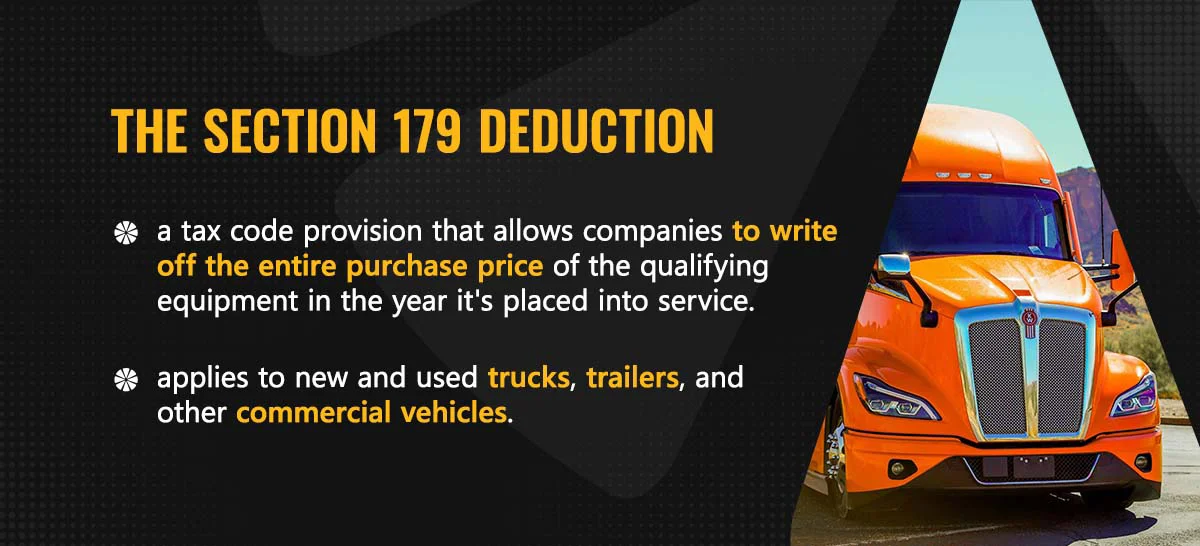
Section 179 is a tax code provision that allows companies to write off the entire purchase price of the qualifying equipment in the year it’s placed into service. As such, Section 179 is a valuable tool that can help you reduce your tax bill and improve cash flow for the current year. It applies to new and used trucks, trailers, and other commercial vehicles.
For the 2025 tax year, the total maximum amount your entire company can deduct across all qualifying equipment is $2.5 million. So, if you’re considering investing in several high-value trucks, you might hit this limit quickly. With this limit, you can identify how much of your capital expenditure on commercial vehicles you can immediately deduct.
The total purchase limit, or phase-out threshold, was $4 million. If the total cost of all the qualifying equipment you purchase and put into service in 2025 exceeds this limit, then your ability to take the Section 179 deduction starts to shrink. To make the most of this opportunity, you must plan the timing and size of your fleet acquisitions, like splitting your purchases across tax years.
Here is a list of general eligibility requirements for Section 179:
- The vehicle must be purchased by an actively trading business.
- It must be purchased by the company, not inherited or gifted.
- The truck must be used for business purposes more than 50% of the time.
- It must be purchased and placed into service within the tax year you’re claiming.
- The asset can be bought as new or used, as long as it is “new to you.”
Trucks with a gross vehicle weight rating (GVWR) of more than 6,000 pounds that are used for business purposes are eligible for the full Section 179 deduction as long as they meet the business use test. Passenger automobiles with a GVWR of 6,000 pounds or less have lower deduction limits.
Lastly, this provision’s deduction cannot reduce your business’s taxable income below zero — it shouldn’t create a net loss for your company. If the deduction is larger than your income, you can generally carry forward any excess amount to future tax years. If you have a lean year or need to make large fleet investments, you may not fully utilize the Section 179 deduction at once.
Using Bonus Depreciation to Your Advantage
Bonus depreciation is another way to accelerate deductions. It allows you to deduct a large percentage of the cost of the qualifying commercial truck in the year it is first put into use. This bonus works similarly to Section 179, but with a key difference — there is no taxable income limit. So, you can create an actual loss for the tax year if you so wish. You may use this loss to offset other income and potentially result in a larger tax refund or smaller tax bill.
Many companies may opt to use Section 179 first, and then the bonus depreciation for any remaining cost of the truck that was not covered by Section 179. In the past, the bonus percentage varied. However, the “One Big Beautiful Bill Act” (OBBBA) was signed into law in July 2025, which permanently reinstated the 100% rate. Note that this rate only applies to qualified property bought and placed in service after January 19, 2025. A 40% rate applies to any assets bought beforehand.
Extra Commercial Truck Tax Benefits
If you own a fleet, you can also take advantage of other tax benefits:
- Fuel: Fuel is often the largest business expense for fleet companies. All fuel-related expenses are considered ordinary business expenses. Just ensure you keep the receipts and accurate logs to support your claims.
- Maintenance: Your fleet needs regular maintenance to operate at its best, especially with high-mileage vehicles. Luckily, maintenance and repairs can also be fully deducted for the year you pay for them.
- Technology: If you use fleet management software or other fleet-related applications and technology, you can deduct their cost. This category can include GPS tracking, dashcams, and other digital fleet management tools.
- Drivers: Labor is likely your second-highest cost. You may be able to fully deduct your drivers’ salaries, benefits, overtime, bonuses, and training. Their per diem allowances can also qualify if properly recorded.
- Operations: Various day-to-day operational costs may be overlooked, but are also deductible. You can include your licensing and registration fees, parking expenses, tolls, permits, and insurance premiums.
- Environment: Depending on your location, your business may also be eligible for federal, state, or local green incentives. Check if there are any incentives available for switching to electric vehicles (EVs) or hybrids.
- Home: If you operate your fleet company from a home office, you may deduct portions of select utilities, equipment, and supplies.
Key Trucking Tax Strategies
Here are several additional tax strategies to maximize all these deductions:
- Track: Maintain accurate logs to show that every deductible cost is documented for proof.
- Separate: Separate personal use and business use so that only legitimate business expenses are claimed.
- Organize: Use a bookkeeping system to help organize your fleet expenses each year.
- Time: Time your truck purchases strategically to take advantage of the most favorable tax year.
- Plan: Plan for the full asset life cycle by considering different factors that affect when to sell, replace, or trade your trucks.
- Align: Try to align your tax strategy with your fleet’s growth by choosing the method of depreciation based on various factors.
- Consult: Partner with a tax professional who is experienced in fleet operations to optimize your tax deductions and find additional opportunities.
Start Your Tax Strategy With the Right Truck From Inland Kenworth
The strongest tax strategy starts with the right truck. A smart investment can help boost your fuel efficiency, reduce maintenance costs, increase operating time, and hold its value longer. All of this helps support a healthier bottom line during tax season.
If you’re ready to upgrade, consider Inland. With over 70 years of experience, our team is here to help you choose a truck that fits your operational and financial needs. Explore our selection of new and used Kenworth trucks or find an Inland dealership near you today.